Sunday, September 4, 2022

A Halloween Lantern Box

 Halloween Lantern Box - Side View #1

Halloween Lantern Box - Side View #2

I previously made a lantern box for my Turtlestitch designs.  Using this design, I added two dormers to the lantern box and some Halloween scenes backed with vellum paper. The designs can be illuminated using a Dollar Tree tea light. The result is a beautiful Halloween decoration for your tabletop.

Here is the PDF file.  I used 65 lb. black cardstock and transparent vellum.

Here is the .Studio file.

Here is the SVG. The file extends past the viewing area.


Make the dormers.  The window tabs are slide into the top and bottom of the dormer.

Glue the tabs onto the lantern box.  Glue the velum onto the inside of each scene. Add the two bats and a witch to the background of the corresponding scene (not the ghosts). Use the throw away cuttings as a template for placement of the bats and witch.

Glue the side tabs together to form the box.

Insert the two bottom tabs as shown.

Insert the last tab to form the bottom of the box.

Slide the inner tabs together to close the interior box.  I used a Glue Dot to close the top flap.

Glue the ghosts on one side of the box.

Glue the ghosts on the other side of the box to complete the Halloween lantern.

Saturday, September 3, 2022

A STEM Project: Slice Forms of Common Quadric Surfaces Part #3

Slice Form of an Elliptic Paraboloid


Side View

I made slice forms of six different quadric surfaces: Hyperbolic Paraboloid aka Monkey Saddle, Ellipsoid, Hyperboloids of One Sheet, Cone, Hyperboloids of Two Sheets and Elliptic Paraboloid.   This post is the third of three posts about quadric surface slice forms.  It is the slice form of an Elliptic Paraboloid. 

Quadric surfaces are the graphs of any equation that can be put into the general form

Ax2+By2+Cz2+Dxy+Exz+Fyz+Gx+Hy+Iz+J=0

where A, … , J are constants. 

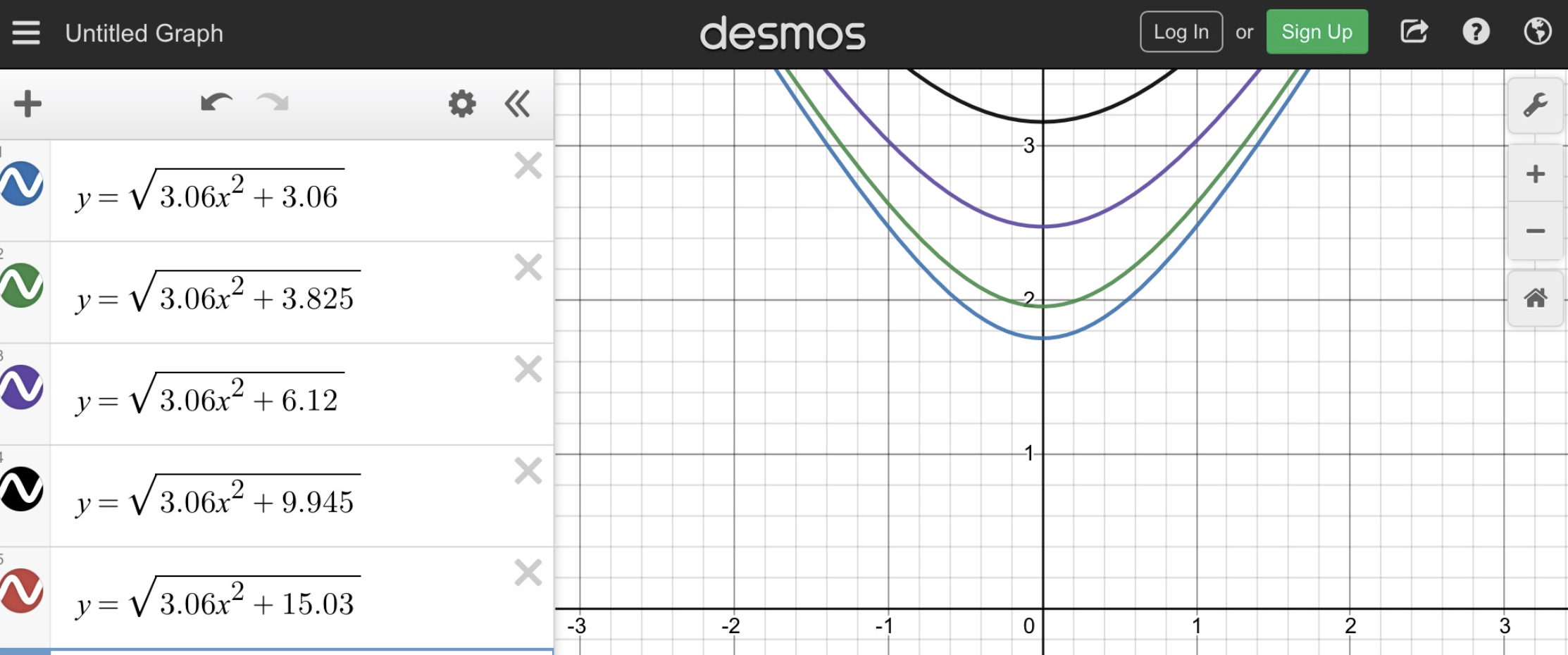
I made all of the slice forms by using this formula. I graphed the quadric surface with the Desmos online graphing calculator, https://www.desmos.com/calculator.  The image created represents the traces needed to form each slice. The slices were then divided by a constant interval of 0.5 inches to create the slits.

Here is the PDF.  I used a good quality 65 lb. cardstock.  The paper needs to be stiff and should not curl.  Otherwise the slices will curl. The slice forms are assembled by sliding the two center slices together.  Next, all of the upward facing slices are slid onto the center slices.  Lastly, all of the downward facing slices are slid onto the center slices.

Here is the .Studio file.

Here is the SVG. The SVG file goes beyond the viewable area.  To see the entire file, zoom out.

Elliptic Paraboloid

An equation of an elliptic paraboloid. 

  • The horizontal cross sections are circles, if a and b are equal. If a≠b, the cross sections are oval.


To make an elliptic paraboloid slice form, with a and b equal(circular base), I used its formula and graphed the surface.  I made traces at constant intervals of 0.5 inches.  These traces represent the slices of the figure.


Elliptic Paraboloid Slice Form lying flat 

Thursday, September 1, 2022

A STEM Project: Slice Forms of Common Quadric Surfaces Part #2

Slice forms of a Hyperboloid of One Sheet, a Cone and a Hyperboloid of Two Sheets
Only one Cone and Hyperboloid of Two Sheets are shown above. To view the actual structure, 
use the app 3D Calculator- GeoGebra. 


View of the slice forms lying flat


I made slice forms of six different quadric surfaces: Hyperbolic Paraboloid aka Monkey Saddle, Ellipsoid, Hyperboloids of One Sheet, Cone, Hyperboloids of Two Sheets and Elliptic Paraboloid.  This post is the second of three posts about quadric surface slice forms.  It will include the slice forms of Hyperboloid of One Sheet, Cone and a Hyperboloid of Two Sheets. 

By using the app 3D Calculator- GeoGebra, all three of the quadric surfaces can be created by changing just one variable, k, by using this formula.

x2a2+y2b2z2c2


When k > 0, a Hyperboloid of One Sheet is created.  Here is the graph at k = 1.


When k = 0, a Cone is created. Here is the graph at k = 0.


When k < 0, a Hyperboloid of Two Sheets is created.  Here is the graph at k = -1.


The slice forms that I created represents this transformation from the hyperboloid of one sheet to the cone and then to the hyperboloid of two sheets. It is interesting to note that as the figure transforms from the hyperboloid of one sheet, the base gets smaller. 

Here is the PDF.  I used a good quality 65 lb. cardstock.  The paper needs to be stiff and should not curl.  Otherwise the slices will curl. The slice forms are assembled (except the Hyperboloid of One Sheet) by sliding the two center slices together.  Next, all of the upward facing slices are slid onto the center slices.  Lastly, all of the downward facing slices are slid onto the center slices.

Here is the .Studio file.

Here is the SVG. The SVG file goes beyond the viewable area.  To see the entire file, zoom out.


Hyperboloid of One Sheet

Slice form of a Hyperboloid of One Sheet

Side View


Equation of a Hyperboloid of One Sheet


x2a2+y2b2z2c2=1


I graphed the quadric surface with the Desmos online graphing calculator, https://www.desmos.com/calculator.  The image created represents the traces needed to form each slice. The slices were then divided by a constant interval of 0.5 inches to create the slits.
This graph represents the top half of the Hyperbola.  
To create the entire Hyperbola, I copied and flipped the image using the Silhouette software.

To assemble, the two center slices are slide into one another and then next set of four slices are slid together.  
Repeat for the remaining slices.

Cone

Slice form of a Cone

Side View

Equation of a Cone.

x2a2+y2b2z2c2=1


Graph of the Cone
(I only graphed one figure because the other is identical)


Hyperboloid of Two Sheets


Slice form of a Hyperboloid of Two Sheets 


Side View


Equation of a Hyperboloid of Two Sheets.

x2a2+y2b2z2c2=1


Graph of the Hyperboloid of Two Sheets
(I only graphed one figure because the other is identical)